Listed as Free on Udemy when checked on 7 November 2026. No coupon or subscription trial is required for the listed lessons. Enrollment needs a Udemy account; availability can change.
About this course
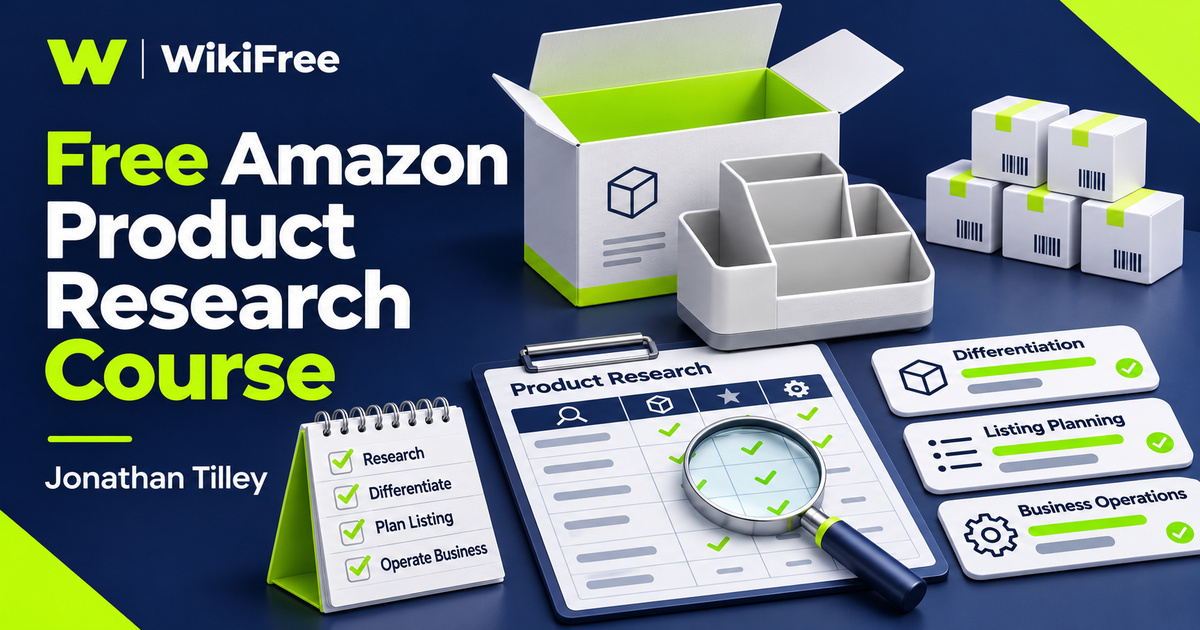
Choosing a product is only one part of preparing an online retail business. You also need a reason for customers to prefer it, a clear listing and a way to manage what happens after launch. This free Amazon product research course, taught by Jonathan Tilley, brings those decisions into one sequence through product research, differentiation, listing optimization and business management.
The English-language course contains four substantial videos totaling two hours, thirty-nine minutes and thirty-two seconds, plus a short closing article. Each video addresses a different stage of the process. There are no stated prerequisites, making the course approachable for a beginner who wants to understand how product decisions connect before committing to stock or a selling operation.
The material was last updated in February 2020. Its product examples, software screens and marketplace assumptions belong to that period. Treat them as examples of a research process, then verify current product conditions and Amazon requirements separately. The course does not establish that a featured niche remains attractive or that following the process will produce sales.
| Official course | A complete guide to launching a product on Amazon in 2020 |
|---|---|
| Created by | Jonathan Tilley |
| Platform | Udemy |
| Language | English |
| Level | Beginner |
| Listed duration | 159 minutes; 5 lectures across 5 sections |
| Completion terms | Not included with a new free enrollment |
What you’ll learn
Follow a product idea through research and validation, compare its physical features with its listing, explore the role of keywords, and identify the operating decisions that continue after launch. Build a clearer distinction between a promising hypothesis, an observed product difference and a result that still needs evidence.
Skills you’ll gain
- Product research questions
- Niche validation concepts
- Differentiation assessment
- Listing information planning
- Keyword research context
- Inventory and service awareness
Turn an idea into research questions
The research lesson begins with where to start, how to examine data and how to select and validate ideas. This gives the course a more useful starting point than choosing an item simply because it looks popular. A product idea can become a set of questions: who might use it, what alternatives exist and what information would support further investigation?
The public lesson summary describes looking for niches with manageable competition and using customer feedback to understand possible improvements. Those are research directions, not proof that a specific product has sufficient demand. Historical examples can help you recognize what the instructor compares, while current information is necessary before making a purchasing decision.
Compare the product with its promise
The second video examines a product through both physical unboxing and its online listing. That pairing matters because the item customers receive and the promises they read should agree. A proposed difference might concern usability, presentation or how clearly the listing explains the product. A different color or a new description alone does not prove that buyers will value the change.
Use this lesson to separate observations from assumptions. An observation could be that an organizer has three compartments; an assumption could be that shoppers prefer that arrangement. The course introduces differentiation as part of product planning. It does not supply a universal formula for creating a competitive advantage or authorize copying another seller’s images, wording or designs.
Plan a clear and accurate listing
The listing lesson moves into keywords and a data-oriented approach to optimization. Its authored description also mentions the Amazon API. These topics can help you think about the relationship between the words customers use, the product information they need and the way a listing communicates that information. More traffic and higher conversion remain outcomes to investigate, not automatic effects of adding keywords.
The recording is not a current integration guide for Amazon’s APIs. Access conditions, available services and software interfaces can change. Amazon’s current selling guidance also emphasizes clear, accurate product information. Use that as a practical boundary: describe the actual item and its supported features rather than treating keyword coverage as permission to make unsupported claims.
Continue the work after launch
The final video returns to the business after launch, covering competitor tracking, profit management, inventory and customer service. This broadens the learning goal beyond publishing a listing. Revenue is different from profit, stock needs ongoing attention and customer questions can reveal issues that product research did not anticipate. These responsibilities require continuing work; the course’s marketing language about passive income is not a dependable operating forecast.
Practice without purchasing stock
For an independent exercise, choose a fictional desk organizer. Write one customer need, list three observable product features and draft two accurate sentences explaining its use. Then note what remains unknown: demand, sourcing costs, shipping, selling fees and returns. Add one inventory question and one customer-service question. This is an editorial practice suggestion, not a supplied worksheet or a product recommendation.
Keep a simple distinction between the recording’s example, your own hypothesis and a fact you have checked for the marketplace you intend to use. That habit makes the lesson sequence useful even when the interface has changed. It also helps you decide which questions need further research before spending money, rather than treating completion of the videos as validation of a business.
Separate learning access from selling costs
The lessons are free under the current offer. Selling on Amazon is a separate activity with selling-plan and referral fees, and optional services such as fulfillment and advertising can add costs. External research software, including tools associated with the instructor’s ZonGuru background, is not included as a promised free subscription. This course offers an introduction to connected product decisions, not guaranteed income, account approval or professional certification.
Related courses for your next step
- Explore a related product-research workflowFree Jungle Scout Extension Course
Compare product tables and historical graphs while keeping tool estimates distinct from guaranteed demand.
Beginner
Frequently asked questions
Is this course suitable for a beginner?
Yes. No prerequisites are stated, and the four videos introduce connected decisions from research to ongoing operations. The examples and interfaces date from 2020.
Does the course confirm that its example products are profitable today?
No. Historical examples demonstrate a process. Current demand, costs, competition and marketplace requirements need separate investigation.
Does free course access include selling fees or research software?
No. Amazon selling fees, optional services and external research-tool subscriptions are separate from free access to the lessons.
Questions & discussion
Share a useful question or correction. Comments appear after moderation. Please avoid personal or sensitive information.