Listed as Free on Udemy when checked on 7 November 2026. No coupon or subscription trial is required for the listed lessons. Enrollment needs a Udemy account; availability can change.
About this course
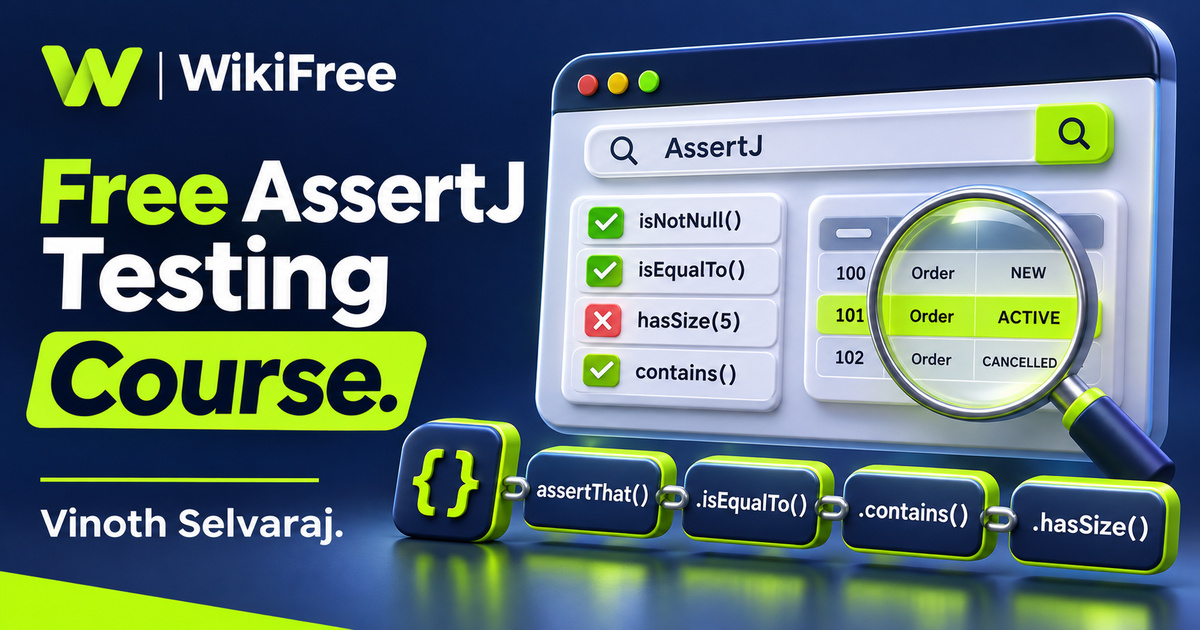
A test can interact with the right page and still tell you very little when it fails. Clear assertions explain what the test expected and where the observed result differs. Vinoth Selvaraj’s Fluent Assertions in Test Automation with AssertJ explores that part of Java testing, first with ordinary values and then with Selenium elements and page objects.
The English course is free to watch on Udemy. It contains twenty videos across three sections, totaling about seventy-five minutes, plus three short article entries. Java and Selenium are listed as prerequisites. Although the source describes the course as suitable for all levels, it is most useful when you can already read Java methods and understand how WebDriver locates and interacts with an element.
| Official course | Fluent Assertions in Test Automation with AssertJ |
|---|---|
| Created by | Vinoth Selvaraj |
| Platform | Udemy |
| Language | English |
| Level | Intermediate |
| Listed duration | 75 minutes; 23 lectures across 3 sections |
| Completion terms | Not included with a new free enrollment |
What you’ll learn
Follow the progression from string, collection and file checks to reusable custom assertions for browser elements and page objects. Compare immediate failures with grouped soft assertions, then examine how an assertion API can express a page expectation more clearly. The emphasis is on readable checks and reusable test structure rather than learning browser automation from scratch.
Skills you’ll gain
- Fluent Java assertions
- Collection expectation design
- Soft assertion lifecycle
- Custom WebElement assertions
- Page-object assertions
- Readable failure design
Make expectations precise
The first section introduces the library and project setup before examining different kinds of values. String assertions make a requirement such as a prefix, length or contained text easier to express as a readable chain. List assertions raise a related question: do you care only about the items present, their order, or a property of each item? The separate lesson on individual list items helps distinguish collection-wide expectations from checks applied to every member.
A file-assertion lesson adds another useful testing context: comparing expected and actual content. The important habit is to decide what equality means for the test before choosing an assertion. Matching a filename, matching text content and matching bytes are different requirements. This short introduction gives you examples to investigate, not a guarantee that one comparison method is appropriate for every file type.
Collect failures without hiding them
Soft assertions allow several checks to be collected so their failures can be reported together. They do not turn failed checks into successful ones. In AssertJ, collected failures must be reported through assertAll or a mechanism that calls it, such as assertSoftly. Understanding that lifecycle matters: a group of checks is useful only when its result is actually surfaced to the test runner.
Extend assertions to browser elements
The second section develops custom assertions for Selenium WebElements. Its sequence moves from the initial custom assertion idea to a reusable implementation, browser-test setup and a search-field demonstration. Checks around displayed state, enabled state and attribute values provide a concrete reason to create a small vocabulary for an interface. A well-named method can make the test’s intention easier to see than a long chain of low-level details.
That vocabulary still needs careful behavior underneath it. A visibility or enabled-state assertion is not, by itself, a waiting strategy. Dynamic pages may need an explicit wait for the relevant condition before a test checks the outcome. Likewise, an element can be displayed and enabled while an overlay prevents an intended interaction. Readable assertions improve expression; they do not automatically remove synchronization problems or prove that an entire user journey works.
Connect page structure with test intent
The course then introduces a base page, a search page and a custom assertion for page objects. These lessons connect reusable page structure with the expectations a test makes about that page. The following refactoring and final-run demonstrations show how those pieces fit together in the example. Treat the base classes as a design to understand and evaluate, rather than a requirement that every test project must use the same inheritance hierarchy.
Two closing lessons in that section address the added complexity and possible next steps. That is a useful question to keep asking as you build abstractions: does a helper remove repeated meaning, or does it hide behavior that a reader needs to understand? A small set of precise assertions can be easier to maintain than a large framework built before a real need appears.
Keep the demonstration in scope
The listing was updated in February 2025. Check current Java, AssertJ, Selenium and browser-driver compatibility before reproducing an older setup. The final section discusses further learning topics; it does not turn this short AssertJ course into complete training in microservices, reactive programming, caching or messaging. The linked source-code article is also distinct from having a ready-to-use framework that has been independently tested in your environment.
Plan assertions before adding abstractions
For optional practice, write expectations for a fictional equipment-search page before implementing any helper. Identify one check for the search field, one for the returned item list and one for a deliberately incorrect result. Then name a custom assertion that would make each expectation obvious to a teammate. This is a separate editorial exercise, not a supplied assignment. Include a failing case in your plan so that you consider the usefulness of the failure message as well as the successful path.
Related courses for your next step
- Review an API project to testFree Node, Express and MongoDB API Course
Explore the behavior of a small web API alongside your study of clear test expectations.
Beginner
Frequently asked questions
Do I need Java and Selenium experience?
Yes. Both are listed as prerequisites. The course concentrates on assertions and reusable testing structure rather than teaching Java or browser automation from zero.
Do soft assertions ignore failures?
No. They collect failures for reporting together. Use assertAll or a supported lifecycle such as assertSoftly that reports the collected result.
Will custom assertions eliminate flaky browser tests?
No. Timing, element changes, test data and environment behavior still require attention. Assertion readability and browser synchronization solve different problems.
Questions & discussion
Share a useful question or correction. Comments appear after moderation. Please avoid personal or sensitive information.