Listed as Free on Udemy when checked on 7 November 2026. No coupon or subscription trial is required for the listed lessons. Enrollment needs a Udemy account; availability can change.
About this course
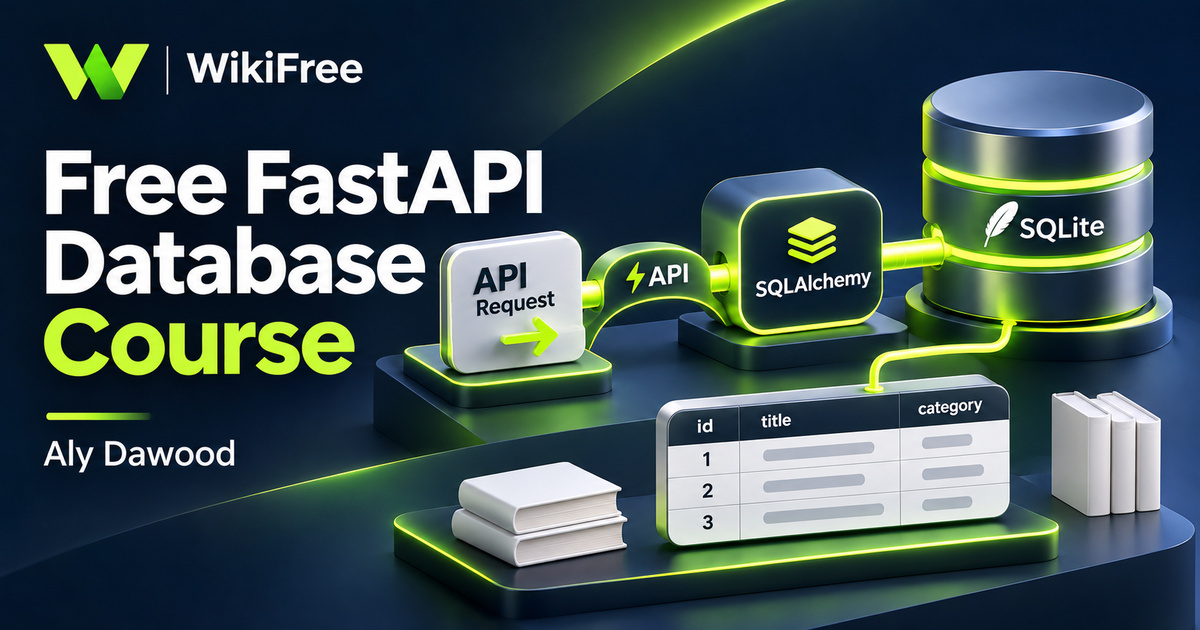
An API becomes more useful when the records it manages can live beyond one running process. This free FastAPI database course follows a books project from request handling toward persistent storage. Aly Dawood uses SQLAlchemy and SQLite to connect Python application objects with database operations, while keeping HTTP responses part of the same workflow.
Crash Course On FastAPI For Web Developers—Level 1 Part 2 continues the instructor’s first installment. Its three sections contain seven videos totaling ninety-five minutes and seventeen seconds, plus five article entries and two quizzes. Sixteen downloadable resources are listed. The largest video develops the books project with a database, making persistence the central addition to the earlier routing work.
The instructor asks learners to complete Part 1 first. Python functions, variables, object-oriented programming, basic web development, command-line skills and introductory database concepts are also prerequisites. Udemy labels this source Beginner, but the continuation and prerequisites make an Intermediate placement more useful here. The listing was updated in September 2025.
| Official course | Crash Course On FastAPI For Web Developers- Level 1 Part 2 |
|---|---|
| Created by | Aly Dawood |
| Platform | Udemy |
| Language | English |
| Level | Intermediate |
| Listed duration | 100 minutes; 12 lectures across 3 sections |
| Completion terms | Not included with a new free enrollment |
What you’ll learn
Connect FastAPI endpoints with database-backed records using SQLAlchemy and SQLite. Follow the roles of an engine, mapped model and session, then relate create, read, update and delete operations to HTTP outcomes. Extend an existing books example while keeping persistence, validation and error handling as distinct responsibilities.
Skills you’ll gain
- SQLAlchemy model concepts
- SQLite persistence
- Database-session lifecycle
- FastAPI dependency patterns
- Database-backed CRUD
- HTTP outcome design
Carry HTTP behavior into the next project
The opening section revisits HTTP status codes and exceptions before applying them to the books API. Those two short topics overlap with Part 1, so the value of this installment lies in the extended example and database section. A missing record, a successful creation and an invalid operation should have distinguishable responses, even when they all pass through the same application.
The books demonstration organizes operations around identifiers and author information. Follow one request from the incoming value through lookup or modification to the outgoing response. That is a more useful way to understand the project than treating each endpoint as an isolated code fragment. It also helps reveal which decisions belong to the API and which belong to the database.
Separate models, connections and sessions
SQLAlchemy introduces another set of responsibilities. An engine provides the database connectivity machinery, a mapped model describes how objects relate to stored rows, and a session coordinates ORM work and transactions. These concepts are related, but they are not interchangeable names for the database itself. Trace where each object is created and how the application obtains it.
The SQLAlchemy lab uses SQLite and introduces a dependency that supplies a database session. The longer books project then develops persistent CRUD operations around a book model. Think about what happens both when a request succeeds and when it fails. A dependency that yields a session can provide a place for cleanup, but closing a session is not the same operation as committing a transaction.
Understand transaction boundaries
Keep flush, commit and cleanup separate in your notes. A flush sends pending changes within the current transaction; it does not by itself mean the transaction has been committed. Commit completes the transaction, while closing a session releases its resources. Understanding these boundaries helps you reason about why an apparent change might not remain after the unit of work ends.
When adapting examples, compare them with the documentation for your installed SQLAlchemy version. SQLAlchemy 2.0 introduced a querying style built around select and Session.execute. The older Query interface remains available as a legacy API, so encountering it does not automatically prove that a demonstration is broken. Check the specific APIs and behavior instead of promising unchanged compatibility across releases.
Follow a record through its lifecycle
For an optional practice activity, outline a catalog with a few books and a unique identifier for each record. Describe what should happen when you create a book, retrieve it, change one field and request an identifier that is absent. After a committed change, consider how you would verify persistence with a new request or application restart. Use your own sample records and keep a short log of the expected and actual result for each request.
Know where this installment ends
Keep the exercise focused on data access and responses. The closing lesson points toward later topics such as authentication, authorization, multiple-table design and testing. Their mention does not turn this short installment into a complete security or production-deployment course. Likewise, article entries labeled assignments and solutions are separate from the seven recorded video lessons.
The recorded course is listed as free. FastAPI, SQLAlchemy and SQLite are open-source tools, while any hosting or external service you choose has its own terms. Use the project to understand how an API and a relational database cooperate, then decide what additional testing, access controls and deployment work your own application needs.
Related courses for your next step
- Strengthen the database foundationFree SQLite Fundamentals Course
Practice local relational-data queries and database basics.
Beginner
Frequently asked questions
Should I complete Part 1 first?
Yes. The instructor explicitly presents this as a continuation and asks learners to complete the first installment before starting.
Is this entirely new material compared with Part 1?
It revisits status codes and HTTP exceptions, then adds an extended books example and SQLAlchemy/SQLite database work.
Does closing a database session commit my changes?
Treat cleanup and transaction completion separately. A session close releases resources; commit is the operation used to complete the transaction.
Questions & discussion
Share a useful question or correction. Comments appear after moderation. Please avoid personal or sensitive information.