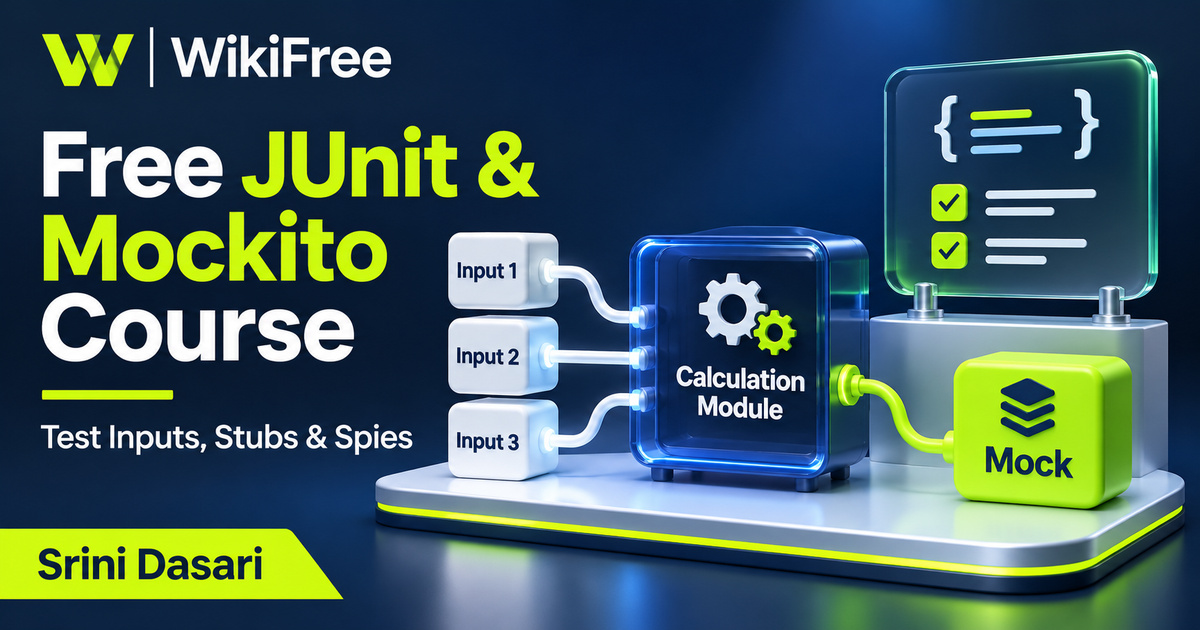
Listed as Free on Udemy when checked on 7 November 2026. No coupon or subscription trial is required for the listed lessons. Enrollment needs a Udemy account; availability can change.
About this course
A useful unit test answers a precise question about a small piece of behavior. Srini Dasari’s introductory JUnit and Mockito course develops that idea through calculation examples, controlled service inputs and test doubles. It is a practical starting point for developers who can already read Java and have some familiarity with Spring Boot.
The free English course contains thirteen videos across two sections, totalling one hour, thirty-three minutes and fifty-seven seconds. The listing was updated in September 2024. Its detailed sequence concentrates on calculations, empty and single-value inputs, service stubs, mocks, annotations, list examples and spies. Use that focused progression to strengthen testing fundamentals before tackling a wider application test strategy.
| Official course | Begin with Junit testing with Spring boot and Mockito |
|---|---|
| Created by | Srini Dasari |
| Platform | Udemy |
| Language | English |
| Level | Beginner |
| Listed duration | 93 minutes; 13 lectures across 2 sections |
| Completion terms | Not included with a new free enrollment |
What you’ll learn
Follow a small calculation from a direct assertion to a service-dependent test. Compare handwritten stubs with Mockito mocks, explore annotation-based setup and examine how spies differ from mocks. Practise choosing meaningful inputs, stating an expected outcome and keeping the behavior under test separate from its dependencies.
Skills you’ll gain
- JUnit assertion reasoning
- Boundary-input selection
- Service-stub design
- Mockito mock setup
- Test lifecycle awareness
- Mock and spy distinctions
Make the test’s question visible
The early lessons introduce repeatable tests and a Spring Boot project environment using Eclipse and Maven. A test should make its intention visible: prepare an input, perform the operation and check an observable result. A passing indicator is useful feedback, but the real question is whether the assertion would fail if the relevant behavior were wrong.
Choose inputs deliberately
The calculation examples expand from ordinary input to empty and single-value cases. This is a valuable change in perspective because a test suite should represent decisions about behavior, not simply repeat the easiest example. Write down what an empty collection means for your operation before choosing an expected result. Treat a null reference as a separate case whose behavior must be deliberately specified.
Control the collaborator
Adding a service dependency creates another question: how can the test supply predictable data? The course first introduces a stub, a small substitute that supplies controlled responses. That can make the test independent of a live database or external source. The important boundary is the contract between the calculation and its collaborator, rather than the details of an environment the test does not need.
Understand what a mock demonstrates
Mockito then provides another way to control the collaborator. Configure only the responses relevant to the scenario and keep the main assertion focused on the result you care about. A mock response describes the test’s chosen situation; it does not demonstrate that a real service behaves the same way. That distinction helps you understand what a unit test proves and where integration checks still belong.
Keep setup understandable
The refactoring lesson introduces @Mock and @InjectMocks to reduce repeated setup. Mockito documents @InjectMocks as a convenience for injecting available mocks and spies, with limits. It is not a general dependency-injection framework that automatically constructs every object in a complex application. Check what is actually initialized so that concise setup does not hide an absent dependency.
Match annotations to the framework
List examples and a dedicated annotations lesson broaden the vocabulary. Pay attention to imports and framework generations when following examples. JUnit Jupiter uses @BeforeEach and @AfterEach for per-test lifecycle methods; JUnit 4 uses @Before and @After. Similar names across tutorials are not a reason to mix incompatible annotations or assume that every test runner will discover them.
Use spies with a clear purpose
The final lesson discusses spies. A spy can call real methods unless those methods are stubbed, so it needs particular care around operations with effects outside the test. Mockito’s documentation also explains why stubbing a spy with the doReturn family can avoid invoking a real method during setup. Choose a spy for a clear reason rather than making it the default substitute for every collaborator.
Plan a small test matrix
For optional practice, describe a service that supplies three quantities to a total-calculation method. Plan cases for several values, one value and no values, then state the expected result for each. Add a separate decision about invalid input. This is an editorial exercise in test design, not an extra assignment or downloadable project included with the course.
Separate the starting point from integration
The broader course description mentions controller, database and Spring test annotations. The detailed lessons support a narrower starting point, so treat full web and persistence integration as further study. Framework APIs also evolve: Spring Boot deprecated @MockBean in version 3.4 in favor of Spring Framework’s @MockitoBean. Check the documentation for your project’s versions before adapting examples.
Check that your test can fail
The videos are free, while any separately chosen hosted services or tools remain outside that offer. No completed deployment, executed laboratory or certificate is promised here. A useful next milestone is writing a small test whose inputs, assertion and dependencies you can explain, then deliberately changing the behavior to confirm that the test detects the difference.
Related courses for your next step
- Develop confidence with programming fundamentalsFree Python Programming Course
Revisit small programs and explicit input-output reasoning in another introductory language.
Beginner
Frequently asked questions
Is prior Java knowledge needed?
Yes. The instructor asks for basic Java and Spring Boot knowledge, even though the course is classified as Beginner.
Does a passing mocked test prove that the database works?
No. A mock supplies controlled behavior inside the test. Real database and service integration need their own appropriate checks.
Can I copy every annotation into a current project?
Check the JUnit, Mockito and Spring versions first. Lifecycle imports differ between JUnit generations, and Spring mock-bean APIs have changed.
Questions & discussion
Share a useful question or correction. Comments appear after moderation. Please avoid personal or sensitive information.