Listed as Free on Udemy when checked on 8 November 2026. No coupon or subscription trial is required for the listed lessons. Enrollment needs a Udemy account; availability can change.
About this course
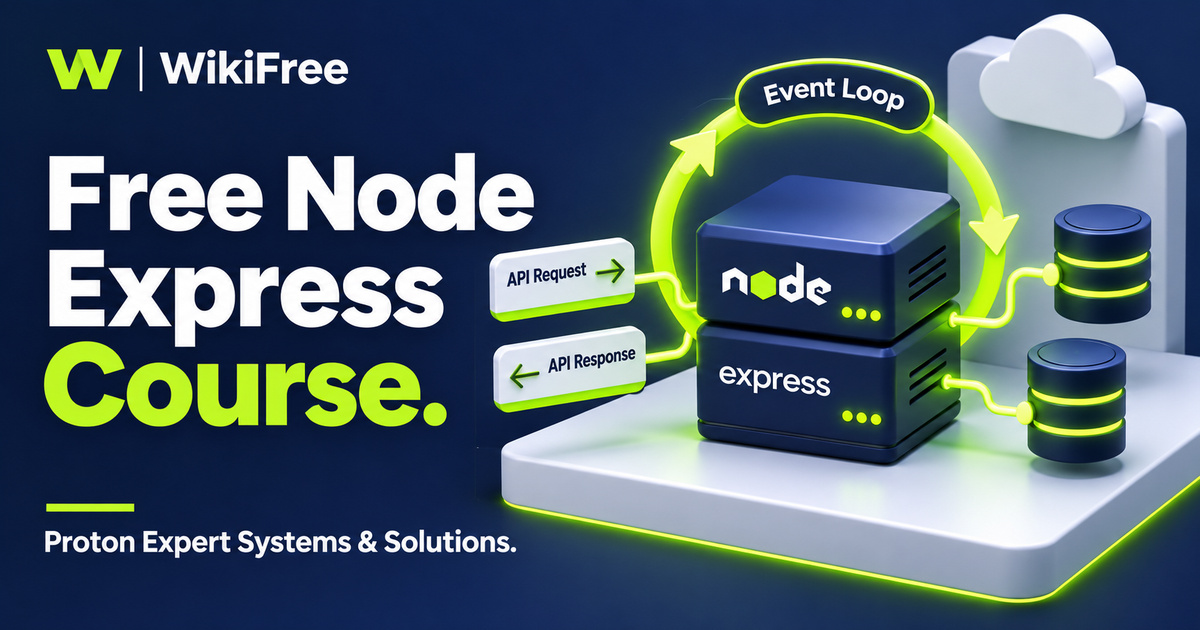
A server application has several jobs to coordinate: receive a request, decide which code handles it, access data and send a useful response. This free Node Express course from Proton Expert Systems & Solutions introduces those connections through short lessons and practical demonstrations. It starts with Node.js setup and moves through events, streams, Express routing and database-backed APIs before a brief serverless example.
The English course contains eight sections and 21 timed lessons, totaling about one hour and 51 minutes. Its title references July 2022, while the page lists an August 2023 update. Treat the demonstrations as an introduction to the architecture and workflow, with package versions and cloud interfaces to check against current documentation. Basic JavaScript knowledge is expected; this is not a first lesson in programming.
| Official course | Application development using NodeJS and Express (Jul 2022) |
|---|---|
| Created by | Proton Expert Systems & Solutions |
| Platform | Udemy |
| Language | English |
| Level | Intermediate |
| Listed duration | 112 minutes; 21 lectures across 8 sections |
| Completion terms | Not included with a new free enrollment |
What you’ll learn
Explore Node.js installation, the REPL, modules and npm package setup. Follow examples of the event loop, asynchronous patterns, EventEmitter and streams before introducing Express and its router. Examine the course’s MySQL and MongoDB API examples, how Postman fits into request testing, and the final transition toward API gateways and an AWS Lambda demonstration.
Skills you’ll gain
- Node.js setup concepts
- Modules and npm orientation
- Event-driven code reading
- Stream processing concepts
- Express route mapping
- Database API tracing
Begin with the runtime, then follow the request
The opening Node.js section combines a general introduction with focused practices on installing the platform, trying the REPL, creating a simple application and exploring modules. A separate npm practice introduces package setup. That sequence helps distinguish the runtime that executes JavaScript from the packages and project files used to organize an application.
Events and streams then receive their own sections. Event-loop and asynchronous-pattern examples are followed by an HTTP example using EventEmitter. Stream lessons introduce stream types, pipes and further HTTP-related practices. These topics offer a useful vocabulary for following data through server code without pretending that a short overview covers every concurrency or error-handling situation.
Keep one distinction clear while studying: an event-driven application is not automatically non-blocking in every operation. Conventional EventEmitter listeners run synchronously when their event is emitted, and long synchronous work can still hold up the event loop. Use the examples to ask what triggers each callback and what work it performs, rather than treating the word asynchronous as a performance guarantee.
Connect routes to two database examples
Express begins with an installation and hello-world practice, then introduces routing. The API section follows with separate CRUD examples using MySQL and MongoDB. This provides two concrete settings for examining the connection between an incoming request, application logic and stored data. It does not establish that the two databases share the same data model or interchangeable query syntax.
The course description includes Postman for testing requests and responses. As you follow the demonstrations, distinguish a request reaching the correct route from a complete, secure application. Authentication, authorization, input validation, error handling and operational testing require their own attention before real deployment. The examples should not be treated as a ready-made production service.
Version awareness also matters. Express 5 changes parts of route-path matching syntax compared with older examples. Check the installed version and its migration documentation if a route behaves differently; do not assume that copying an older string pattern into a newer project will preserve its meaning.
Approach the cloud section with a clear scope
The later lessons introduce an API gateway using Express and then a serverless application using Node.js and AWS Lambda. The final practice description also mentions DynamoDB and Postman. These are compact demonstrations, not a comprehensive AWS architecture, security or operations program.
Watching the course is free. Creating your own cloud resources is a separate decision: API Gateway, Lambda, DynamoDB and associated services have their own account conditions and possible charges. Review current service pricing and cleanup requirements before reproducing a deployment. The page lists 14 downloadable resources and seven quiz titles; their presence does not establish the contents, answers or completeness of a project repository.
Make a request map of your own
For an independent exercise, sketch a fictional reading-list API on paper. Write a request method and path, identify its route handler, describe the intended data operation and specify the response you would expect. Add one missing-record case and one invalid-input case. This is an editorial study exercise, not an instructor assignment or a claim that the course includes this project. It gives you a way to organize questions before running code or opening a cloud account.
Understand event-loop blocking: Node.js explains why long synchronous work can delay other requests. Review Express version changes: Express documents route syntax changes and migration context.
Related courses for your next step
- Inspect API requests and responsesFree Postman API Testing Course
Explore requests and response checks in a separate API-testing introduction.
Beginner
- Continue into JavaScript conceptsFree JavaScript Scope and Async Course
A later topic after learning JavaScript fundamentals.
Intermediate
Frequently asked questions
Is JavaScript experience required?
Yes. The listed requirements include basic JavaScript, Node.js installation and a Windows-oriented editor setup. The course introduces server-side tools rather than teaching programming from zero.
Does the free course include free AWS hosting?
No such hosting entitlement is established. The lessons are free to view, while cloud resources have separate terms and possible usage charges.
Is this a complete production backend course?
It is a short introduction with Node.js, Express, database and serverless examples. It does not promise a secure production application, compatibility with every current package version, certification or employment.
Learner reviews
Tell other learners what you actually tried. Reviews are moderated and may come from learners who have started or completed the course.
No published learner reviews yet.
Sign in to write a reviewQuestions still belong in the discussion below. Review and ranking rules.
Questions & discussion
Share a useful question or correction. Comments appear after moderation. Please avoid personal or sensitive information.