Listed as Free on Udemy when checked on 7 November 2026. No coupon or subscription trial is required for the listed lessons. Enrollment needs a Udemy account; availability can change.
About this course
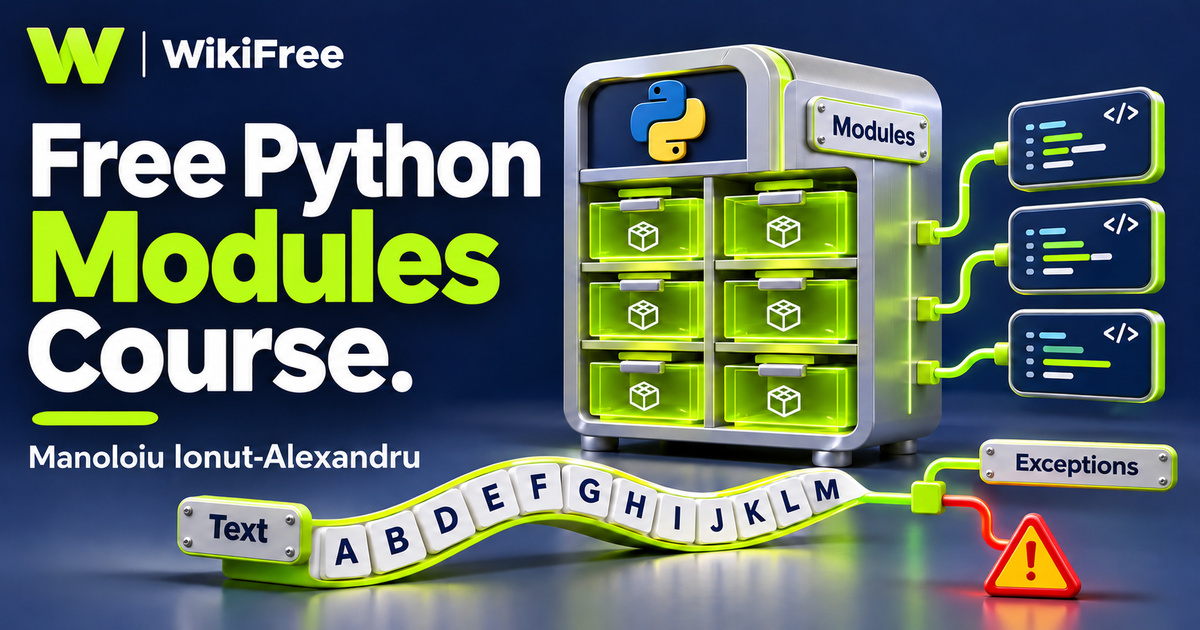
A Python script becomes easier to maintain when its parts have clear responsibilities. Reusable calculations belong in modules, text needs deliberate processing, and failures need a response that matches their cause. Manoloiu Ionut-Alexandru’s PCAP Theory Part 1 course brings these concerns together in a short introduction to organizing and reasoning about Python programs beyond the first few statements.
The English lessons are free to watch on Udemy. Four sections contain nine videos totaling about eighty-six minutes, with seven downloadable resources listed. Although the subtitle calls the course beginner-friendly, its prerequisites include variables, loops and functions. It is best approached after an introductory Python course or equivalent practice. Earlier PCEP study is recommended by the instructor, but it is not a requirement.
| Official course | PCAP Certification – Python Theory Study Guide (Part 1) |
|---|---|
| Created by | Manoloiu Ionut-Alexandru |
| Platform | Udemy |
| Language | English |
| Level | Intermediate |
| Listed duration | 86 minutes; 9 lectures across 4 sections |
| Completion terms | Not included with a new free enrollment |
What you’ll learn
Distinguish importing a module from installing a package, explore standard-library modules, and understand how your own code can be organized into packages. Examine strings as immutable text, choose suitable operations for searching and combining them, and follow the way exceptions move through a program. Use these ideas to make short scripts more understandable before building larger applications.
Skills you’ll gain
- Module import reasoning
- Package organization
- Virtual environment concepts
- String manipulation
- Exception hierarchy awareness
- Explicit error handling
Prepare a small Python workspace
The opening lessons introduce the wider study path and a Python development setup using PyCharm. They explain installation, editor configuration and creating a first project. Recorded setup screens can change, so use the current instructions for your operating system and chosen Python release when installing tools.
Know where your code comes from
The modules section starts with several import forms, including aliases and importing selected names. As you study an example, identify where a name comes from instead of treating every function as automatically available. The lesson uses math, random and platform to connect imports with numerical operations, random selection and information about the host environment.
User-defined modules and packages then introduce a way to divide your own work. The lesson discusses __name__, __pycache__, nested packages and module search behavior. The bytecode cache is part of how Python manages imported code; it is not a replacement for your source files. The __name__ value helps distinguish a module running as the main program from one imported elsewhere, a useful foundation for separating reusable functions from demonstration code.
The package discussion also includes __init__.py. This file belongs to the regular-package model demonstrated in many introductory examples, but it is not a universal requirement for every modern Python package: namespace packages are an exception. Likewise, a name presented as non-public by convention is not protected by a security barrier. These distinctions prevent a simple teaching model from turning into an incorrect absolute rule.
Separate environments from installation
The pip lesson addresses installing, listing, upgrading and removing packages, together with virtual environments. Keep the two roles separate: pip installs and manages distributions, while venv creates an isolated Python environment. A project environment helps keep one project’s dependencies apart from another’s.
Treat text as structured data
The strings section moves from character representation to everyday operations. Unicode code points and UTF-8 encoding are related but different concepts: text values are not the same thing as their encoded bytes. Indexing, slicing, iteration, concatenation and comparison give you tools for examining text. Because Python strings are immutable, an operation that produces changed text returns a new value rather than editing individual characters in place.
The next lesson covers property checks, joining, splitting and searching. Pay attention to return values and failure behavior when choosing a method. For example, find can signal that a substring is absent, while index raises an exception in that situation. Sorting also needs precise terminology: strings do not provide an in-place sort method. The list.sort method changes a list, whereas sorted returns a new list from an iterable.
Respond to failures intentionally
The final section examines exception handling and the built-in exception hierarchy. Catching an exception should correspond to a failure you know how to handle. A broad handler can accidentally hide an unrelated problem, while a specific handler makes the intended response clearer. The lessons also introduce raising exceptions and defining custom exception classes, giving you vocabulary for representing failures that matter to your own program.
Assertions appear as a development aid. They are useful for stating assumptions, but they must not be the only validation of user input or a security condition because optimized Python execution can remove them. Use explicit checks and appropriate exceptions for requirements that must always be enforced.
Keep the scope of Part 1 clear
The broad learning goals mention objects, lambdas and closures, but the nine lessons in this first part concentrate on setup, modules, packages, strings and exceptions. The instructor directs learners to Part 2 for the continuation. Its certification panel names PCAP-31-03; Python Institute now publishes PCAP-31-04 with additional objectives. Compare the official syllabus for your intended exam version rather than assuming that either short course guarantees full coverage or a passing result. Exam registration and vouchers are separate from free viewing.
Try a modular text exercise
For optional practice, plan a small place-name cleanup utility. Put reusable text functions in one module, decide how to split and rejoin sample names, and specify an explicit response to an invalid input type. Describe which exception a caller should receive and what the main script should display. This editorial exercise is separate from the supplied resources and gives the course’s three main themes a shared purpose.
Related courses for your next step
- Build confidence with basic PythonFree Python Programming Course
Review variables, decisions and introductory programming before this intermediate theory course.
Beginner
Frequently asked questions
Do I need to complete a PCEP course first?
PCEP study is recommended but not required. You should already understand Python variables, loops and functions.
Does Part 1 teach the entire object-oriented syllabus?
No. Its dedicated lessons focus on modules, packages, strings and exceptions. The instructor directs learners to Part 2 for further topics.
Is PCAP certification included?
No. Free access to the lessons does not include an exam voucher or award the credential. Verify the current exam objectives and registration requirements separately.
Questions & discussion
Share a useful question or correction. Comments appear after moderation. Please avoid personal or sensitive information.