Listed as Free on Udemy when checked on 8 November 2026. No coupon or subscription trial is required for the listed lessons. Enrollment needs a Udemy account; availability can change.
About this course
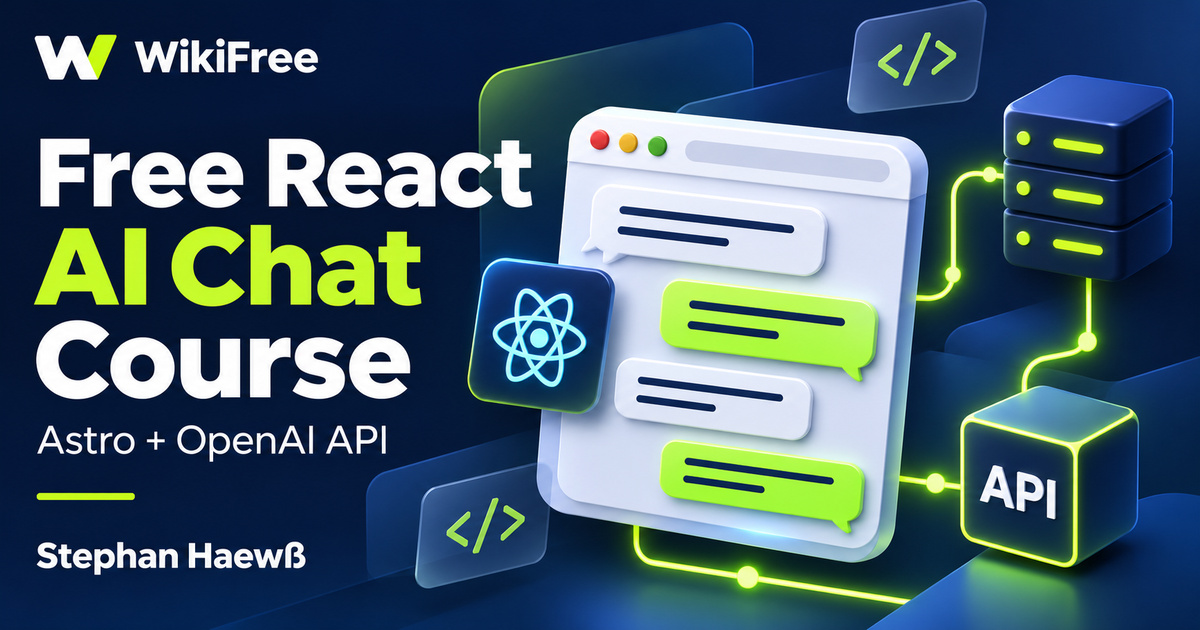
A chat interface looks simple until you ask where a message goes after someone presses Send. This free course by Stephan Haewß follows that journey through a React interface, an Astro server endpoint and the OpenAI API. Its appeal is the small project: you can concentrate on the connections between the pieces without first designing a large application.
The course is aimed at developers who already understand modern JavaScript and have some React experience. It is an introduction to this particular integration, rather than a first programming course. The public curriculum contains two sections and twelve items, with about fifty-eight minutes of listed material. The focus is one basic chat application; the instructor’s larger paid programme is separate.
| Official course | Build a ChatGPT-Like App with JavaScript, React & OpenAI |
|---|---|
| Created by | Stephan Haewß |
| Platform | Udemy |
| Language | English |
| Level | Intermediate |
| Listed duration | 58 minutes; 12 lectures across 2 sections |
| Completion terms | Not included with a new free enrollment |
What you’ll learn
You will explore how a browser interface sends input to a server, how server code calls a language-model API, and how the returned message becomes something the user can read. The project also introduces conversation history as a sequence of messages. That provides a useful way to distinguish a single question-and-answer request from a chat that supplies earlier turns as context.
Skills you’ll gain
- React interface composition
- Astro project setup
- Server endpoint concepts
- API request flow
- Conversation message structure
- Client and server separation
Trace the request before adding features
The opening section introduces the tools and the OpenAI platform. The project section then moves through creating an Astro application, adding React, preparing the API connection and creating an endpoint. This order makes the server boundary visible: the interface collects input, while the server handles the external request. Understanding that boundary is more valuable than memorising a particular folder name or command.
Later lessons connect a user message to the request, build a basic React interface and introduce chat history. Read those stages as separate responsibilities. A button click, an HTTP request and a model response are connected events, but they are not the same event. If the interface displays nothing, the fault might be in the input handling, server response or rendering step. Mapping those boundaries gives you a clearer starting point for investigation.
Understand what conversation history means
Conversation history gives a model access to earlier messages included with a request. It does not mean that a model has learned those messages permanently. It is also different from saving a conversation reliably for a particular signed-in user. The course’s small example offers a starting point for understanding message flow, not evidence of a complete account system or production storage design.
A server-side array, by itself, does not establish durable storage or separation between users. For a later application, you would need to decide who owns each conversation, how long it is retained, and which requests may retrieve it. Those are extension decisions to investigate after the introductory project. Avoid using personal or confidential material while experimenting with a demonstration.
Follow the concepts alongside current documentation
The listing was updated in October 2025 and includes an article about API and Astro changes. The visible lesson summaries refer to Chat Completions and an older model example. OpenAI continues to support Chat Completions, while recommending Responses for new projects. Treat the course as a route into the concepts and check current SDK syntax, available models and framework instructions before adapting its examples.
Keep API credentials on the server, outside browser-delivered code and source control. A React interface can request a reply from your own backend without receiving the secret key itself. This distinction matters even for a small project: a working local demonstration does not automatically establish safe public access. Hosting, access controls, request limits and error handling deserve their own review before deployment.
Try a small message-flow exercise
As an optional Coursya practice idea, sketch a fictional workshop assistant with two short messages: a request for a session outline and a follow-up asking for a shorter version. Label the interface, server endpoint, external API and displayed reply. Then explain which earlier message must accompany the follow-up for its meaning to be clear. This is an editorial exercise, not an advertised instructor assignment.
You can complete that planning exercise without making paid requests. If you decide to reproduce the live API integration, check the API account’s billing and usage arrangements first. Free access to these lessons does not promise free API calls, hosting or a certificate. ChatGPT and API billing are separate. The useful outcome is a clearer understanding of the application’s request path and the questions to resolve before building further.
Compare current API approaches: Review migration guidance alongside older examples. Review API key safety: Keep credentials outside client code.
Related courses for your next step
- Develop JavaScript foundationsFree JavaScript Scope and Async Course
Explore language concepts behind asynchronous interfaces.
Intermediate
- Practice interface presentationFree CSS Product Page Layout Course
Develop layout skills for your own web pages.
Beginner
Frequently asked questions
Is this suitable for someone new to JavaScript?
The course expects good JavaScript knowledge and basic React understanding. Learn those foundations first if components, events and asynchronous requests are unfamiliar.
Does the free course include OpenAI API usage?
No API credit allowance is promised by the course. API usage and any hosting costs are separate from watching the listed lessons.
Will I build a production-ready replacement for ChatGPT?
The scope is one basic chat project. It does not establish production security, user accounts, persistent storage or feature parity with ChatGPT.
Learner reviews
Tell other learners what you actually tried. Reviews are moderated and may come from learners who have started or completed the course.
No published learner reviews yet.
Sign in to write a reviewQuestions still belong in the discussion below. Review and ranking rules.
Questions & discussion
Share a useful question or correction. Comments appear after moderation. Please avoid personal or sensitive information.