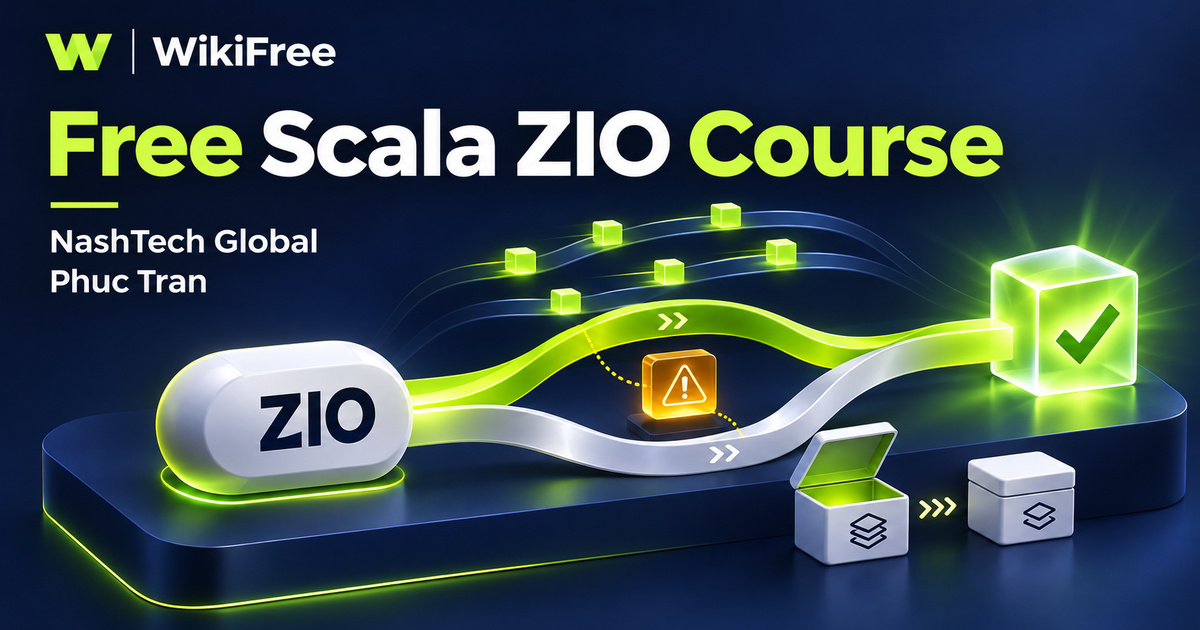
Listed as Free on Udemy when checked on 8 November 2026. No coupon or subscription trial is required for the listed lessons. Enrollment needs a Udemy account; availability can change.
About this course
Reading a value, responding to a failure, and closing a resource are often taught as separate programming tasks. ZIO gives Scala developers a way to describe these actions as effects and combine them deliberately. Scala ZIO in 1 Hour, listed under NashTech Global and Phuc Tran, offers a short introduction to that approach through console examples, error handling, resource management, and fibers.
The course targets learners who already understand basic Scala syntax. Its six sections contain seventeen recordings totaling about 58 minutes. The emphasis is ZIO 1.0, with material last updated in November 2022, so approach it as a focused introduction to that version's concepts and vocabulary. It is a starting point for understanding effectful programs, not a promise of production readiness after an hour.
| Official course | Scala ZIO in 1 Hour |
|---|---|
| Created by | NashTech Global, Phuc Tran |
| Platform | Udemy |
| Language | English |
| Level | Intermediate |
| Listed duration | 58 minutes; 17 lectures across 6 sections |
| Completion terms | Not included with a new free enrollment |
What you’ll learn
Understand how an effect describes work to be performed, follow console input and output through a sequence of effects, and compare several ways to respond to a declared failure. Explore finalization and the acquisition, use, and release of resources. Then examine how fibers let work proceed concurrently and how joining a fiber lets another part of a program wait for its result. Basic Scala familiarity will help you focus on these relationships rather than on language syntax alone.
Skills you’ll gain
- Effect composition
- Console workflows
- Typed error handling
- Recovery policies
- Resource lifecycle design
- Fiber coordination
Build a sequence you can explain
After setup and a small greeting example, the basic operations section introduces effects, console interaction, chaining, and sequential operators. This is where the course starts connecting individual actions into a program. The central learning question is simple: which action must finish before the next one can use its result? Expressing that dependency clearly makes a sequence easier to discuss and review.
When studying the examples, distinguish describing an action from running it. Follow the values that pass between effects, and note which combinations keep one result or combine several. A concise expression is useful when its behavior remains understandable. You should still be able to explain the input, output, and possible failure of each step without relying on the code's visual appearance.
Choose recovery to match the failure
The error section moves through Either, catching, fallbacks, folding, and retrying. These are different decisions rather than interchangeable ways to hide an error. A fallback offers another action; a fold gives you a way to handle the two outcomes; a retry policy repeats work under specified conditions. The practical question is what your application should do when the original action cannot complete.
Keep ZIO's declared error channel separate from unforeseen defects. The official version 1 documentation explains that the error type describes anticipated failures, while defects can exist outside it. Converting a typed failure into an Either value does not make every possible termination disappear, and catchAll should not be described as a universal handler for defects and interruption. These distinctions help you read the examples without overestimating what the type signature guarantees.
Plan cleanup alongside the useful work
Resource handling follows error handling for a reason: a failed action can still leave cleanup to do. The course introduces finalization and the older bracket pattern for acquiring a resource, using it, and releasing it. When tracing a file example, give closing the resource as much attention as reading its contents. The lifecycle is part of the design, not an afterthought attached only to successful execution.
For an independent practice exercise, sketch a program that reads a small local configuration file and prints a summary. Mark the acquisition, processing, and release stages. Decide which anticipated failure could justify a fallback file and which should be reported. This is an editorial exercise for applying the concepts, not a downloadable project promised by the course. Avoid adding retries automatically: first explain whether repeating the operation is appropriate.
Understand what the fibers are coordinating
The final technical section introduces fibers, forking, and combining fork with join. Fibers are scheduled by the ZIO runtime; they are not simply another name for operating-system threads. Concurrency also does not imply that every task will execute at the same instant or that a program will necessarily run faster. Trace which operations can proceed independently and where a result is actually required.
Before practicing with newer dependencies, consult the migration guide. ZIO 2 changed several APIs, including the older bracket name to acquireReleaseWith. Match examples and documentation to the version you choose instead of combining snippets from different versions blindly. Watching the course is free, while any optional services you use for experiments have separate terms. Treat the short lessons as preparation for further practice, testing, and careful design.
Review ZIO migration changes: Keep version-specific API names distinct. Understand declared failures and defects: Read the limits of the typed error channel.
Related courses for your next step
- Explore another functional languageFree Elixir Basics Course
Compare introductory patterns and functions in Elixir; this is a different language, not a Scala prerequisite.
Beginner
Frequently asked questions
Do I need to know Scala first?
Yes. The course lists basic Scala syntax as a requirement. It introduces ZIO concepts rather than teaching Scala from the beginning.
Does this teach the latest ZIO API?
The stated scope is ZIO 1.0. Later versions changed names and other behavior, so use the relevant version documentation and migration guidance when adapting examples.
Are resources, certification, or production outcomes guaranteed?
The listing advertises two downloadable resources, whose contents are not described here. No certification, deployment readiness, or guaranteed performance outcome is promised by this article.
Learner reviews
Tell other learners what you actually tried. Reviews are moderated and may come from learners who have started or completed the course.
No published learner reviews yet.
Sign in to write a reviewQuestions still belong in the discussion below. Review and ranking rules.
Questions & discussion
Share a useful question or correction. Comments appear after moderation. Please avoid personal or sensitive information.