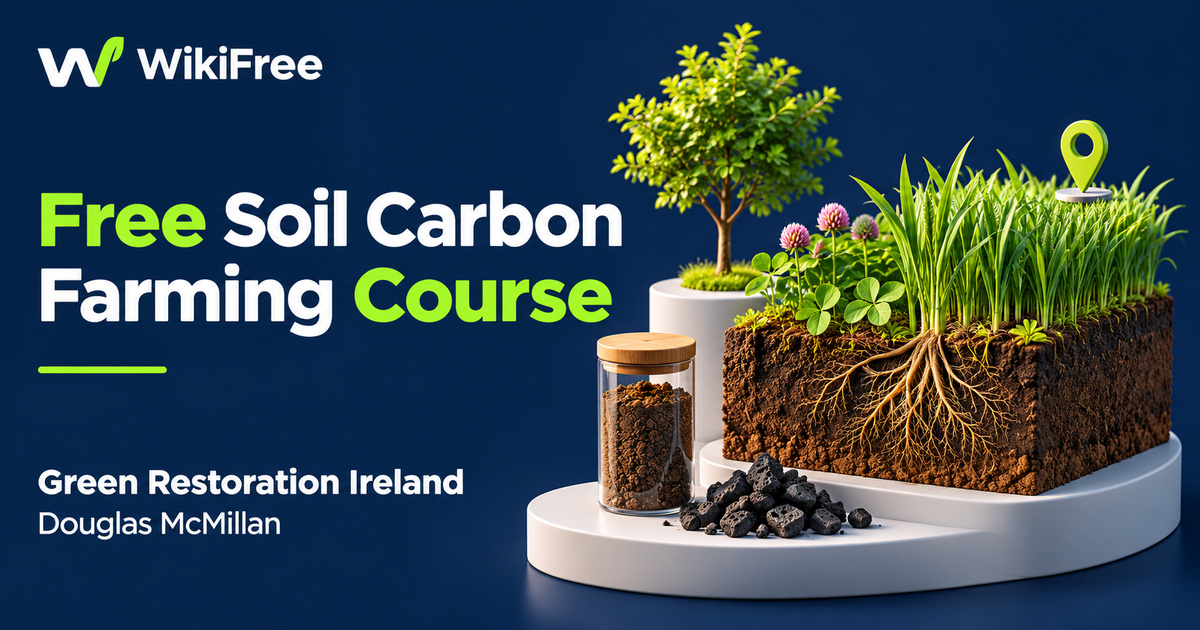
Listed as Free on Udemy when checked on 7 November 2026. No coupon or subscription trial is required for the listed lessons. Enrollment needs a Udemy account; availability can change.
About this course
Carbon farming raises two different questions: what is changing in the soil, and what evidence would make that change credible? This free course offers a starting point for considering both. Its value is in connecting a practical land-management discussion with the language of measurement and verification, so learners can approach later conversations with clearer questions.
Green Restoration Ireland and Douglas McMillan list Rehydrate, Regenerate, Earn on Udemy. The material brings together an on-farm session featuring Alexandre Cottin and a webinar featuring Bernhard Aumann, recorded in 2025. Despite the peatland wording in the subtitle, the described teaching includes a substantial focus on mineral soils. Choose it as an introduction to soil carbon and farming options, rather than a complete engineering plan for changing a peatland's water levels.
| Official course | Rehydrate, Regenerate, Earn |
|---|---|
| Created by | Green Restoration Ireland; Douglas McMillan |
| Platform | Udemy |
| Language | English |
| Level | Beginner |
| Listed duration | 114 minutes; 5 lectures across 5 sections |
| Completion terms | Not included with a new free enrollment |
What you’ll learn
Explore the course's stated themes of soil organic matter, carbon measurement, humus-building, agroforestry and biochar. The learning objectives also introduce GPS-referenced sampling and the EU Carbon Removals and Carbon Farming framework, or CRCF. A useful learning goal is to distinguish a proposed practice, an observed outcome and a claim that has actually been independently verified.
Skills you’ll gain
- Soil carbon vocabulary
- Sampling questions
- Land-management comparison
- Baseline reasoning
- Verification literacy
- Evidence-based discussion
Two recorded sessions, with time to reflect
The listed sequence has five sections: an introductory article, two parts of the on-farm training, and two webinar parts, with two knowledge checks placed alongside the recordings. The four videos total about 113 minutes. This is a manageable format for studying one part, making notes and returning with questions, instead of treating the title's promise of earnings as an immediate practical outcome.
Farmers, landowners, advisers and students may find the comparison of approaches useful. You do not need to own a farm to examine the ideas. For an initial pass, keep a short vocabulary list and separate observations about soil health from statements about a particular payment arrangement. This makes the material easier to revisit without assuming that a recorded example applies to every location or soil type. Mark uncertainties explicitly so an attractive example does not become an unsupported planning assumption.
Separate a farming practice from a certified result
The European Commission describes carbon farming as land-management practices that can increase carbon storage or reduce greenhouse-gas emissions from soils. Those are related but distinct outcomes. Preserving an existing carbon stock should not automatically be described as the same quantity of new carbon removed from the atmosphere. Keep the claimed outcome explicit when comparing explanations and examples.
The CRCF is a voluntary certification framework with quality criteria and independent verification requirements. Watching a course, adopting a practice and obtaining certified results are separate steps. Scheme recognition involves technical assessment, formal decisions and ongoing requirements; it is not granted by a training platform. Before relying on a commercial proposal, check its applicable methodology, monitoring responsibilities, costs and actual payment terms. No universal carbon-credit price or guaranteed farm income is established by this course listing.
Try a comparison before making a commitment
As an optional study exercise, imagine an adviser comparing two proposals for a fictional field: maintaining a cover crop and adding trees. Write down the intended outcome for each, the starting information you would request, the observations you would want over time and the questions that remain unanswered. Add a separate column for commercial claims, leaving it blank where there is no evidence. This exercise is an editorial suggestion, not an advertised course assignment or a recommendation to alter real land.
Finish by drafting three questions for a qualified local adviser. For example: which soil conditions matter here, what evidence would distinguish improvement from normal variation, and who would check the result? The aim is a more informed conversation. The recordings can support that preparation, while field investigations, project design, certification and participation in any payment scheme remain separate activities with their own requirements.
European Commission: CRCF: Background on the voluntary framework and independent verification. Certification scheme recognition: Current recognition process and published application status.
Related courses for your next step
- Explore wetter land useFree Wetland Farming Course
Explore recorded experience with peatland farming, crops and markets.
Beginner
- Compare crop usesFree Reed Harvesting Course
Consider wetland crop processing and market context.
Beginner
Frequently asked questions
Is the course free, and are project costs included?
The listed Udemy lessons are offered free in English. That does not make laboratory sampling, field work, professional advice or certification free. Check each outside service or scheme separately.
Does completing it certify carbon credits or guarantee payment?
No. Course study does not establish a verified carbon result, scheme recognition, eligibility for payments or a sale. These depend on the relevant project and certification requirements. A completion credential is not promised here.
Is this a complete peatland restoration course?
The course includes broader land-use context, but its described sessions emphasize soil carbon and mineral-soil farming tools. Do not treat it as a site-specific rewetting design, permitting assessment or complete restoration plan.
Questions & discussion
Share a useful question or correction. Comments appear after moderation. Please avoid personal or sensitive information.