Listed as Free on Udemy when checked on 7 November 2026. No coupon or subscription trial is required for the listed lessons. Enrollment needs a Udemy account; availability can change.
About this course
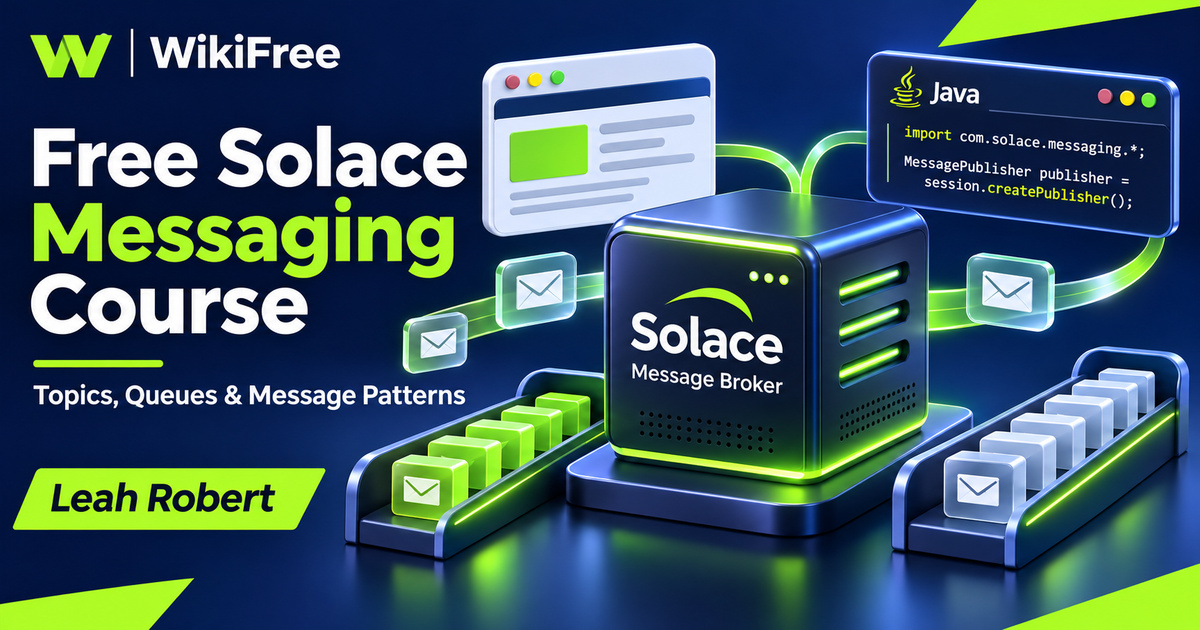
A distributed application needs more than a collection of services. Its parts must exchange information in ways that match the work they are doing. Leah Robert’s Fundamentals of Solace Development introduces that problem through messaging concepts and a small chat application, connecting topics, queues and request-reply patterns with practical application components.
The free English course has thirty-one videos across five sections, with one hour, thirty-five minutes and eighteen seconds of video. The listing dates from December 2018. It is introductory to Solace, but previous development experience is required, alongside a Java JDK and Apache Maven. Basic networking knowledge is helpful. Treat the examples as a foundation to adapt against current product and API documentation.
| Official course | Fundamentals of Solace Development |
|---|---|
| Created by | Leah Robert |
| Platform | Udemy |
| Language | English |
| Level | Beginner |
| Listed duration | 95 minutes; 31 lectures across 5 sections |
| Completion terms | Not included with a new free enrollment |
What you’ll learn
Explore why applications use a message broker, connect a JavaScript sample to Solace and compare publish-subscribe with queue consumption. Follow a request-reply example using Java and REST, then examine competing consumers and a Docker-based broker environment. Build vocabulary for explaining how a message travels between application components.
Skills you’ll gain
- Message-broker concepts
- Topic and subscription design
- Queue-consumption reasoning
- Acknowledgment awareness
- Request-reply patterns
- Competing-consumer basics
Understand the broker’s role
The opening section introduces messaging and the Solace product environment. The key idea is separating an application’s decision to publish an event from the set of applications interested in receiving it. A broker helps route that exchange. This can support distributed designs, but it does not make every service independent automatically: the meaning of the message and the expectations of its consumers still matter.
Trace the application connection
The application section uses a browser-based chat example to make the exchange visible. Before following connection settings, identify the client, broker and intended destination. A host address, credentials and Message VPN identify different parts of the connection context. Understand their roles without treating the demonstration’s values as settings for an unrelated environment.
Give topics a clear purpose
The topics lesson introduces structured topic names and subscription filtering. Think of a topic as routing information that expresses what a message concerns. A thoughtful naming scheme helps consumers subscribe to relevant information without depending on the publisher’s internal code. The course also distinguishes direct messaging from guaranteed messaging; choose between delivery approaches according to the behavior the application actually needs.
Locate storage and consumption
Queue lessons show another part of the design. A queue can retain matching messages for consumers, while subscriptions determine which published messages reach it. This is different from imagining that a topic name is itself a stored mailbox. When tracing an example, identify where storage occurs, which consumer is bound to the endpoint and what acknowledgment means at each stage.
Distinguish receipt from completed work
Solace documents separate transport and application acknowledgments. Receiving data inside a client API is not the same as the application finishing its work. With automatic acknowledgment, the callback returning can trigger the application acknowledgment. Unacknowledged messages can be redelivered after a consumer disconnects, so delivery guarantees should not be presented as an unconditional promise that a business operation executes exactly once.
Follow the response path
The multi-protocol section connects a browser request with Java-side processing through the broker. Request-reply adds a response path to the exchange, making it useful to ask how the requesting component identifies the reply it expects. The course’s login example illustrates that message pattern. It is not a complete production identity system, and protocol translation alone does not establish application security.
Share work across consumers
The load-balancing section uses a non-exclusive queue so multiple consumers can share incoming work. For a non-partitioned queue, Solace describes round-robin delivery and possible reordering when unacknowledged work is delivered to another consumer. This is work distribution, rather than a promise that every connected consumer receives every message or that completion order is globally fixed.
Keep the local example in context
The Docker appendix introduces a locally run broker and its management interfaces, followed by web transport, REST and SMF connection details. It provides another environment for understanding the same messaging concepts. Review current image requirements, port exposure and authentication before adapting any historical setup. Local demonstration credentials and connections should not be copied into an exposed service as a production template.
Sketch a failure-aware exchange
For optional practice, sketch a small order-notification example. Identify one publisher, a topic, a queue subscription and two consumers sharing work. Write down what happens when a consumer disconnects before acknowledging a message, and how the application could recognize repeated work. This is an editorial design exercise, not an additional instructor assignment, supplied repository or executed laboratory.
Choose a realistic next milestone
The course videos are free; a separately chosen hosted broker, infrastructure or service plan can have its own conditions and costs. The sample repository and external setup materials are not represented here as independently tested. Your next milestone is being able to explain the path and responsibility of each message, then validate the implementation with the documentation and tools appropriate to your environment.
Related courses for your next step
- Understand a container-based development environmentFree Docker Containers Course
Explore container concepts before adapting a local broker demonstration.
Beginner
Frequently asked questions
Is this suitable without development experience?
The instructor requires previous development experience, a Java JDK and Apache Maven. Beginner refers to the introduction to Solace, not to programming from zero.
Does guaranteed messaging mean business processing happens exactly once?
No unconditional exactly-once business outcome is established by that label. Understand acknowledgments, redelivery and the application’s handling of repeated work.
Are cloud services included free with the videos?
The course videos are free. Hosted brokers, infrastructure and other separately chosen services have their own terms and possible costs.
Questions & discussion
Share a useful question or correction. Comments appear after moderation. Please avoid personal or sensitive information.