The Coursya library
Free Online Courses
Explore free study options. Check the provider, prerequisites, and certificate details before you begin.
Course results
4936 courses
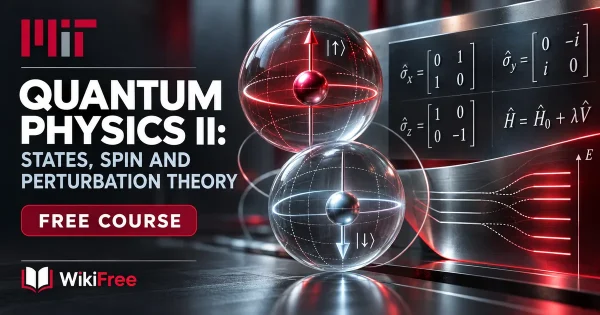
Continue quantum mechanics through states, operator notation, multipartite systems and angular momentum. The lectures develop the formal tools needed for more advanced quantum reasoning.
Explore AI game programming through MIT's Battlecode teaching sessions. The videos examine navigation, strategic algorithms and lessons from a programming tournament rather than offering access to a…
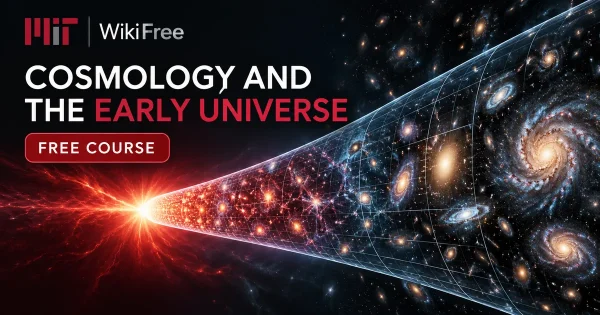
Study the early universe through expansion, thermal history and inflation. MIT lectures connect cosmological models with the physical reasoning used to describe large-scale evolution.
Continue atomic and optical physics with precision measurement, light-matter dynamics and trapped-ion examples. The lectures develop quantitative models used to understand coherent control and quantum experiments.
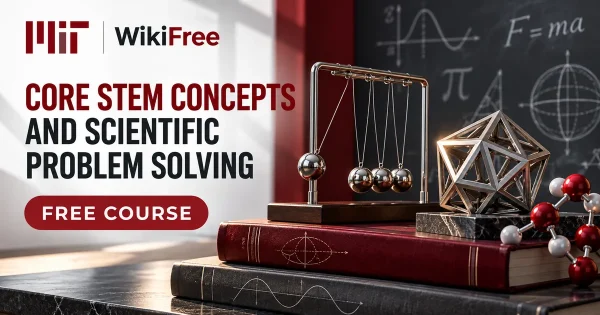
Review a varied collection of core STEM ideas through focused explanations. Topics range from mechanics and equilibrium to modeling and communication, making this a cross-disciplinary concept collection.
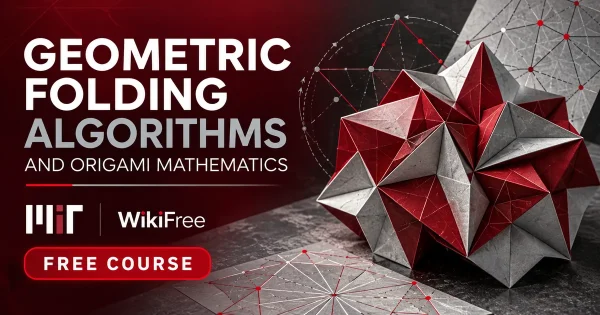
Explore algorithms and geometry through linkages, origami, rigidity and unfolding. The lectures connect physical folding questions with mathematical proofs and computational problems.
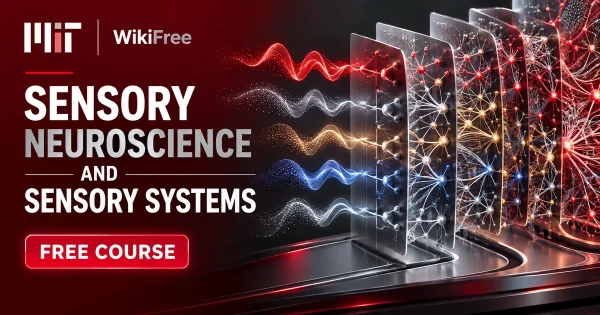
Investigate how neural systems process vision and hearing. Lectures connect adaptation, color, eye movements and auditory responses with methods for understanding sensory computation.
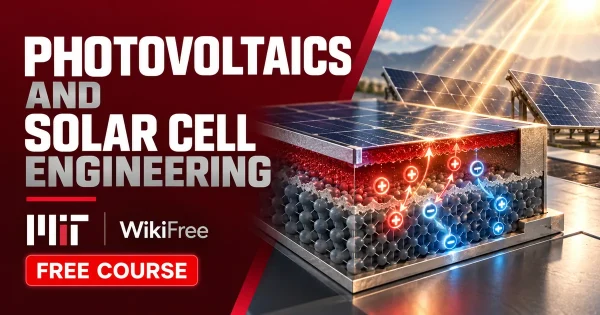
Study photovoltaic devices through light absorption, charge transport, extraction and advanced solar-cell concepts. The lectures connect semiconductor physics with the losses and design choices that shape performance.
Explore algorithms used to study genomes, RNA and protein networks. MIT lectures connect computational methods with biological questions about sequence, structure and interaction.
Develop atomic and optical physics through resonance, atomic structure, light-matter interactions and spectral line broadening. The course emphasizes the physical models behind experimental observations.
Investigate biological systems through network motifs, feedback, robustness and adaptation. The lectures connect simplified mathematical models with patterns found in cells and developing organisms.
Study the limits of efficient computation through reductions, satisfiability and hardness of approximation. MIT lectures connect formal complexity classes with examples of difficult algorithmic problems.