The Coursya library
Free Online Courses
Explore free study options. Check the provider, prerequisites, and certificate details before you begin.
Course results
5264 courses
Study television as a medium through historical development, genres and critical discussion. The classroom recordings support analysis of how television programs and broadcasting practices create meaning.
Explore lasers and optics through laboratory demonstrations. The videos show interference, optical fibers and laser phenomena, providing visual support for conceptual study without requiring laboratory equipment.
Observe electromagnetic principles through recorded demonstrations of charge, conduction, induction and waves. The collection connects visible experimental effects with concepts from electromagnetic-field theory.
Develop models for systems that evolve randomly in discrete steps. The lectures examine Markov chains, rewards, dynamic programming and related tools for analyzing stochastic behavior.
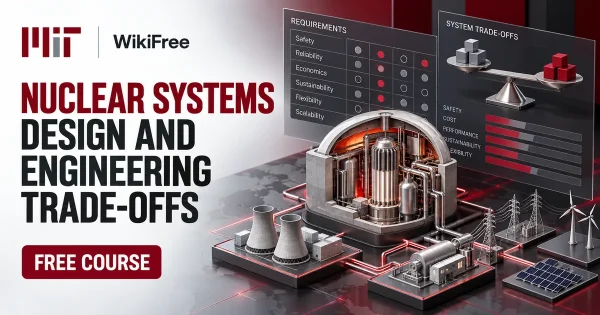
Study nuclear systems as a multidisciplinary engineering-design problem. Lectures and project presentations examine requirements, trade-offs and nonconventional reactor concepts at an academic level.
Trace MIT's development alongside changing ideas about technology and education. The lectures examine institutional history, wartime research, aerospace, computing and campus life.
Explore economic approaches to poverty through education, credit and policy evaluation. MIT lectures connect concrete development questions with evidence about how interventions affect people's opportunities.
Study transport at small scales through statistical physics and molecular descriptions. Lectures connect heat capacity, diffusion, the Boltzmann equation and molecular simulation with nanoscale behavior.
Explore electromagnetic engineering through recorded laboratory introductions and demonstrations. Topics include motors, magnetic effects, spectroscopy and tunneling; equipment and supervised laboratory participation are not included.
Learn introductory MATLAB programming through files, functions, scripts and debugging. The short video sequence explains how to organize simple computations and inspect common programming problems.
Develop signals-and-systems reasoning through time-domain and frequency-domain representations. MIT lectures connect continuous and discrete signals with the mathematical description of system behavior.
Explore energy technologies in the context of sustainable development. The recordings combine lectures, laboratory demonstrations and project presentations involving fuels, conversion and practical energy needs.