The Coursya library
Free Online Courses
Explore free study options. Check the provider, prerequisites, and certificate details before you begin.
Course results
5264 courses
Explore algorithms used to study genomes, RNA and protein networks. MIT lectures connect computational methods with biological questions about sequence, structure and interaction.
Develop atomic and optical physics through resonance, atomic structure, light-matter interactions and spectral line broadening. The course emphasizes the physical models behind experimental observations.
Investigate biological systems through network motifs, feedback, robustness and adaptation. The lectures connect simplified mathematical models with patterns found in cells and developing organisms.
Study the limits of efficient computation through reductions, satisfiability and hardness of approximation. MIT lectures connect formal complexity classes with examples of difficult algorithmic problems.

Examine sustainability within supply-chain decisions through reverse logistics, carbon footprints, life-cycle analysis and stakeholder engagement. These selected lectures focus on evaluating consequences across a product's wider system.
Develop statistical mechanics from thermodynamics and kinetic theory toward classical ensembles and interacting particles. The lectures connect microscopic models with macroscopic physical behavior.
Explore the collaborative production of video games through project work and design discussions. The recordings include classroom instruction, presentations, studio perspectives and reflections on the development process.

Study cinema through its history, expressive techniques and major filmmakers. The lecture collection connects film analysis with developments in comedy, classical Hollywood, neorealism and international cinema.
Explore advanced theoretical connections between gravity, strings and holography. Lectures examine large-N methods, D-branes and relations between bulk and boundary descriptions.
Learn how to communicate scientific ideas through educational video. The course examines storytelling, storyboarding, production choices and revision, supported by project screenings and educator reflections.
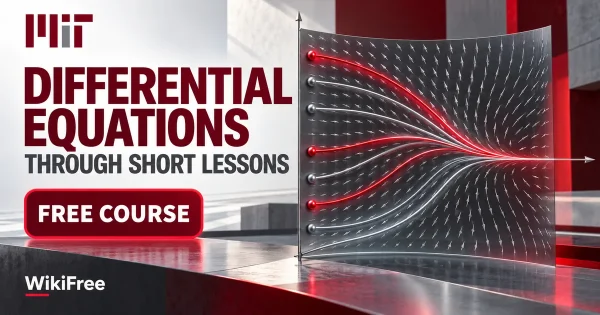
Learn differential equations through concise lessons on response, stability, transforms, matrices and numerical methods. The series combines analytic ideas with demonstrations from the MATLAB ODE suite.
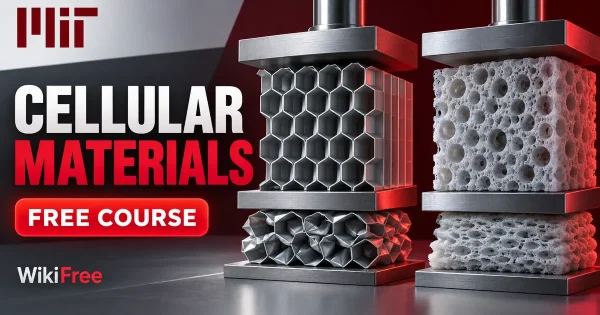
Explore how cellular structure changes the mechanical behavior of materials. Lectures examine honeycombs, foams, biological examples and tissue-engineering scaffolds, connecting geometry with material properties.