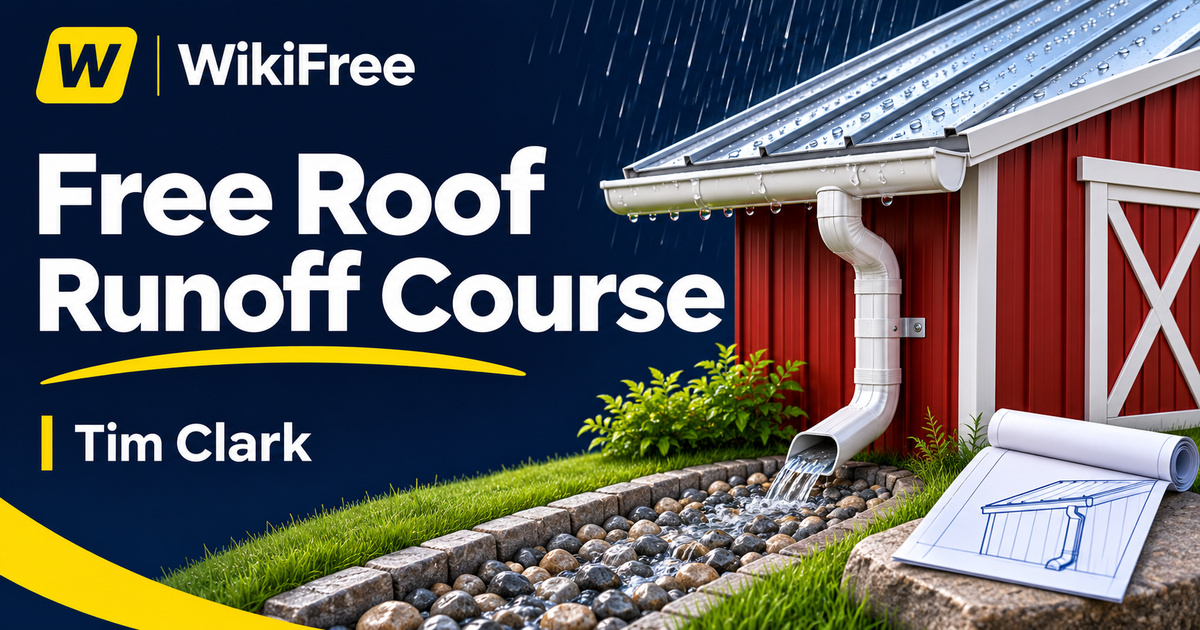
Listed as Free on Udemy when checked on 7 November 2026. No coupon or subscription trial is required for the listed lessons. Enrollment needs a Udemy account; availability can change.
About this course
Rain falling on an agricultural roof can become a management problem when its discharge reaches a yard, erodes soil or mixes with contaminated runoff. This free roof runoff course introduces the planning questions behind collecting that water and moving it along an appropriate drainage route. It gives beginning conservation technicians a focused way to connect hydrology, gutters, downspouts and drip trenches.
Tim Clark organizes the material around NRCS Roof Runoff Structure Standard 558. Four sections contain ten videos totaling about an hour, a separate standard-reading item and an open-book quiz. The lessons progress from the purpose of the practice to gutter and trench examples, then a course project. Treat the course as an introduction to a design process, with current local criteria and qualified review still needed for an actual installation.
| Official course | Roof Runoff Structure Design (NRCS Standard 558) |
|---|---|
| Created by | Tim Clark |
| Platform | Udemy |
| Language | English |
| Level | Beginner |
| Listed duration | 60 minutes; 11 lectures across 4 sections |
| Completion terms | Not included with a new free enrollment |
What you’ll learn
Follow the relationship between roof runoff estimates and component capacity. Explore the distinct flow problems in a gutter and at a downspout, compare gutter systems with drip trenches, and see how spreadsheet examples connect calculations to a layout. Use the reading, exercise introductions and project discussion to identify the information that a complete design must document.
Skills you’ll gain
- Roof runoff planning
- Hydrologic units checking
- Gutter flow concepts
- Downspout capacity reasoning
- Drip trench comparisons
- Design documentation review
Start with the site and the standard
The opening lesson explains why separating roof water matters and introduces two approaches: collecting flow along the eaves or receiving it in a drip trench. Before focusing on a component, describe the problem the system is intended to solve. A useful learning sketch identifies the contributing roof, the collection route and the eventual outlet. This sketch is an editorial study exercise, not a dimensioned construction plan.
The standard-reading item is central to the course, rather than an optional background detail. NRCS directs users to the applicable Field Office Technical Guide for local practice documents; its national standards are not intended to be used directly to plan, design or install a practice. Check the current state version and supporting documents. The recording was last updated in March 2022, so a reference described as current in a lesson should not automatically be treated as current today.
Follow water through the whole system
The hydrology lesson introduces conversion of rainfall and roof-area information into a flow rate. Keep the meaning and units of each input visible as you study the example. A rainfall depth, an intensity and a discharge are different quantities. Avoid carrying a numerical value from a demonstration into another location without confirming the applicable rainfall basis, contributing area and design requirements.
The gutter section separates open-channel flow along the gutter from flow through its outlets. That distinction makes the spreadsheet demonstration easier to follow: a satisfactory result for one component does not establish the capacity of every downstream component. The construction discussion and practice introduction connect these calculations to layout choices. Use them to ask what assumptions, elevations and outlet conditions the example depends on, rather than assuming that one illustrated arrangement fits every building.
Turn examples into review questions
The drip-trench section revisits the runoff problem with a different collection arrangement. Its hydraulics, construction and exercise lessons give you a second way to organize the same planning questions. Compare how water enters each system, how it moves onward and what information is needed to evaluate the outlet. These comparisons build understanding without turning the course summary into a set of construction specifications.
The final project brings the preceding topics together through a design problem using the course spreadsheets. The public description also refers to worksheets, a possible exercise solution and additional design references. Their individual contents are not evaluated here. As you study any downloaded material, distinguish supplied data from your assumptions and record the version of each reference you use; a completed spreadsheet alone does not establish that a project satisfies local criteria.
Plan study time and next steps
The listed preparation includes basic Excel familiarity, access to a computer with Excel and the ability to print worksheets. Software access and printing are separate from free viewing of the lessons. The instructor estimates roughly four hours for an entry-level learner to work through the material, which is broader than the recorded video time. Allow time to read, pause, repeat calculations and review questions.
The course project description mentions a New York Conservation Approval Authority submission process. Do not assume that watching the recordings, submitting an exercise or completing a free enrollment currently grants that authority, a professional credential or permission to approve a design. Confirm any present-day assessment arrangements with the responsible organization. The immediate value of the course is a clearer framework for studying roof-water collection and discussing a proposed system with an appropriately qualified reviewer.
Find the current NRCS 558 reference page: Use the official page to locate national information and state-specific guidance. Understand the Field Office Technical Guide: Find the role of localized standards and supporting practice documents.
Related courses for your next step
- Review the hydrology backgroundFree Small-Watershed Hydrology Course
Explore a separate introduction to runoff estimation and watershed reasoning.
Beginner
- Explore another water-related measurement topicFree Hydrographic Surveying Course
Study a separate introduction to locating soundings in hydrographic surveying.
Beginner
Frequently asked questions
Does this course qualify me to approve a real design?
No such qualification is promised here. The recording mentions a New York approval pathway, but current eligibility, assessment and authorization must be confirmed with the responsible organization.
Is the course four hours of video?
No. Ten videos total approximately one hour. A separate reading item, an open-book quiz, exercises and a project account for additional study; the instructor estimates about four hours of overall work.
Is Excel included with the lessons?
No. The course expects Excel access and basic spreadsheet familiarity. Software entitlement and printing costs are separate from the free recorded lessons.
Questions & discussion
Share a useful question or correction. Comments appear after moderation. Please avoid personal or sensitive information.