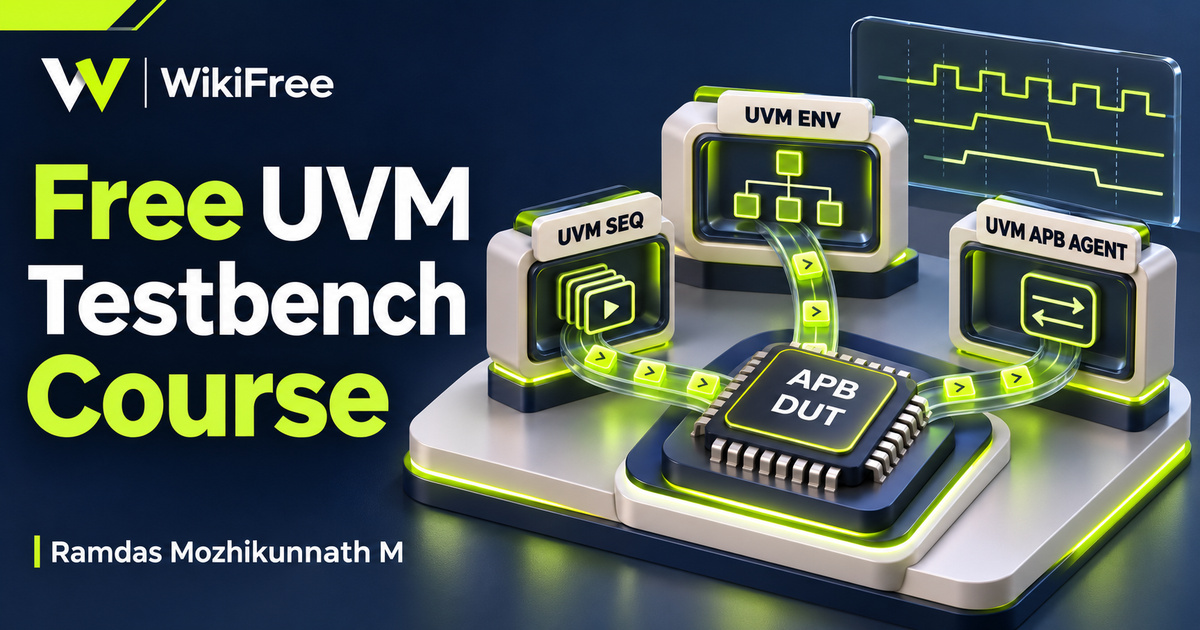
Listed as Free on Udemy when checked on 9 November 2026. No coupon or subscription trial is required for the listed lessons. Enrollment needs a Udemy account; availability can change.
About this course
A testbench becomes easier to understand when each component has a clear responsibility. One part describes the transactions you want to generate, another drives an interface, and another observes what happened. This free UVM testbench course introduces that separation through transaction-level communication, reusable components and a guided APB example.
Ramdas Mozhikunnath M teaches the English-language course for learners who already understand functional verification, SystemVerilog and object-oriented concepts. The source labels it All Levels; Coursya maps it to intermediate because of those prerequisites. Its seven listed sections contain 36 lectures, comprising 34 videos and two presentation-type items. Three quizzes and 36 resources are listed separately. The examples use UVM while also discussing its relationship with OVM.
| Official course | Learn to build OVM & UVM Testbenches from scratch |
|---|---|
| Created by | Ramdas Mozhikunnath M |
| Platform | Udemy |
| Language | English |
| Level | Intermediate |
| Listed duration | 327 minutes; 36 lectures across 7 sections |
| Completion terms | Not included with a new free enrollment |
What you’ll learn
Explore layered testbench architecture, transaction-level modeling, ports, exports and analysis communication. Follow the construction of drivers, sequencers, monitors, agents, environments and tests. Study sequence-based stimulus, factory concepts and configuration, then connect those ideas with the APB transaction, interface and component examples.
Skills you’ll gain
- Testbench responsibility mapping
- Transaction-level communication
- UVM component organization
- Sequence-based stimulus planning
- Factory and configuration concepts
- APB example analysis
Give every component a reason to exist
The opening material asks why verification methodologies are useful and introduces a layered architecture. Start by identifying which decisions belong to a test and which behavior belongs closer to the interface. Separating those concerns gives you a vocabulary for discussing reuse. Accellera describes UVM as an API standard with a SystemVerilog class-library reference implementation that supports reusable verification environments; adopting the vocabulary alone does not validate a design.
The transaction-level modeling section then examines ports, exports, FIFOs and analysis communication. A producer-and-consumer example offers a smaller setting in which to think about communication before moving into a larger hierarchy. When studying it, write down what information is transferred, who initiates the exchange and which component receives it. Keep that logical exchange distinct from the signal-level details of a hardware interface.
Follow transactions through the hierarchy
The component lessons introduce a driver and sequencer, their connection, a monitor, an agent, an environment and a test class. They also discuss build, connect and run phases. Draw a hierarchy as you move through these topics, adding each connection only when you can explain its purpose. This helps you recognize the difference between creating an object, linking components and generating activity during a run.
The next section develops sequence items, sequence methods, driver interaction and different generation styles before introducing virtual sequences. Factory and configuration lessons follow. Together, these topics encourage you to ask which parts of an environment should remain reusable and which choices should vary between tests. Treat the examples as material to understand and adapt carefully, rather than assuming that a copied class will work unchanged in every project.
Connect the architecture with the APB example
The APB section brings the earlier building blocks into one example. It introduces the protocol and architecture, then moves through a transaction and interface, driver and sequencer, monitor, agent and environment, sequences, and a top-level test and simulation discussion. Use this order to trace the relationship between the planned transaction and the observations at the interface. The article does not promise a particular APB revision, protocol-compliance certification or a production-validated verification environment.
For an editorial exercise, sketch a fictional peripheral interface and create a responsibility table with five entries: transaction, sequencer, driver, monitor and test. Give each one a single job, then describe the path of one read request through your sketch. Add a separate question about how you would decide whether the observed result was correct. This exercise is original to the article; it is not a supplied assignment or evidence that any simulation has been executed.
Study the material with its boundaries in view
The end-of-test item is a presentation-type entry whose description still says a video is coming soon. The final section has no listed lectures. Do not rely on either as a complete delivered lesson on ending tests or as an advanced UVM program. The resource-instructions item also has a description that does not match its title closely enough to establish what its download contains. Resource and quiz bodies are not reviewed here.
The listing was last updated in July 2015. Accellera now distributes newer reference implementations, so check the library version and simulator documentation before applying older examples. OVM and UVM should not be treated as interchangeable installations. Recorded lessons are free; external simulator access, accounts and licensing are separate matters. This introduction offers a structured study path, without promising complete solution files, current tool compatibility, employment or a certificate with a new free enrollment.
Explore Accellera’s UVM resources: Official information about the methodology and its reference implementation.
Related courses for your next step
- Review the underlying verification languageFree SystemVerilog SOC Verification Course
Revisit language foundations and the broader verification workflow.
Intermediate
- Explore a separate digital-design workflowFree VHDL Digital Circuits Course
Connect digital hardware concepts with gates, adders and state machines.
Intermediate
Frequently asked questions
Is this a first programming course?
No. The stated prerequisites include functional verification, SystemVerilog and object-oriented concepts. The examples focus on organizing a verification environment.
Are all listed sections complete video training?
No. The end-of-test presentation entry still describes a forthcoming video, and the final section lists no lectures. These are not counted as delivered advanced video lessons.
Will the examples run unchanged with a current simulator?
That is not guaranteed. The material dates from 2015; check the selected UVM library, simulator support and any account or licensing requirements before attempting the examples.
Questions & discussion
Share a useful question or correction. Comments appear after moderation. Please avoid personal or sensitive information.